PPE Detection Software: A Simulated AI Video Analytics Demonstration
PPE detection software can turn a visible gap in hard-hat or high-visibility-vest use into a time-stamped event for a safety lead to review. In US manufacturing, the Bureau of Labor Statistics recorded 306,500 non-fatal work injuries in 2024, at 2.5 cases per 100 full-time workers. In Great Britain, HSE estimates 55,000 manufacturing workers sustained a workplace non-fatal injury across its 2022/23–2024/25 average period; 23% were absent for more than seven days, and HSE recorded 11 worker fatalities in provisional 2024/25 data. These measures use different methods and do not isolate PPE failures, but they show why earlier visibility matters. Here's what Horus detects when we simulate this scenario.
Disclaimer: This article describes a hypothetical demonstration using Horus in a simulated operational environment. All scenarios are illustrative only. The event timing, confidence scores, rule coverage, and impact estimate are not a live customer result or a measured Horus safety-performance claim.
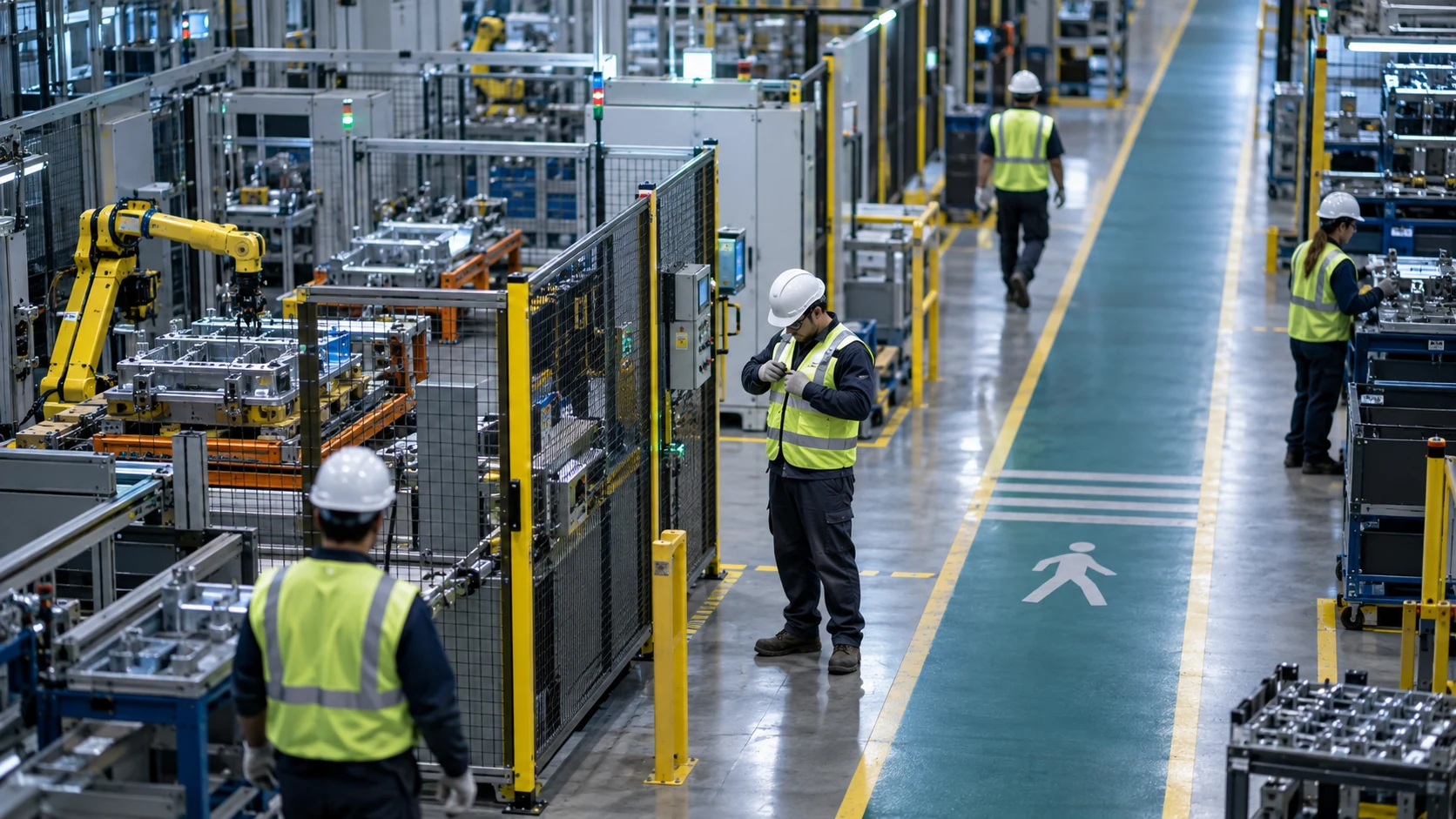
The scenario setup
The simulated site is a medium-sized manufacturing floor with a guarded automated cell, a marked pedestrian walkway, and an access point where operators collect parts. An RTSP-compatible IP camera watches the cell entrance, with a Windows PC available for local processing.
The safety lead defines one PPE rule: a tracked person must wear a hard hat and high-visibility vest inside the marked area. A high-severity event starts when a missing item remains visible for five seconds; a cooldown prevents duplicate alerts. A real site would validate camera angle, lighting, PPE colours, occlusion, shifts, and local procedure before relying on the rule.
The research baseline
The US and UK sources describe the scale of manufacturing injury through complementary measures:
- BLS reports 306.5 thousand non-fatal work injuries in private manufacturing in 2024, with 2.5 total recordable cases per 100 full-time workers in its industry chart.
- HSE's Manufacturing statistics in Great Britain, 2025 estimates that 55,000 workers reported a workplace non-fatal injury in the average period from 2022/23 to 2024/25, about 2.1% of manufacturing workers; 23% resulted in more than seven days away from work.
- HSE recorded 8,853 employee non-fatal injuries under RIDDOR in provisional 2024/25 manufacturing data: 2,463 specified injuries and 6,390 injuries that incapacitated a worker for more than seven days.
- HSE recorded 11 fatal injuries to manufacturing workers in 2024/25p and gives a five-year average fatal-injury rate of 0.62 per 100,000 workers, around 1.5 times the all-industry rate.
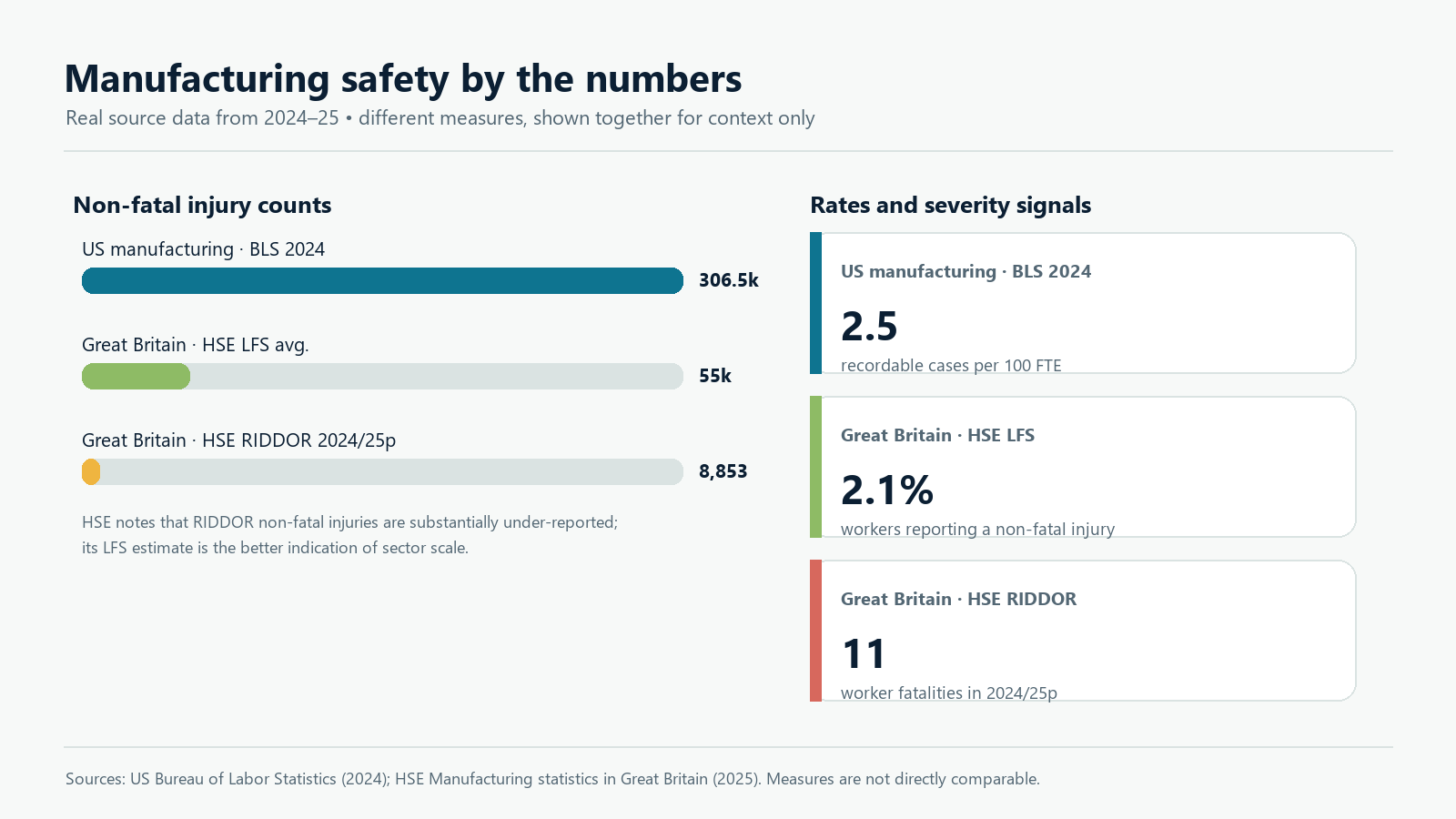
These figures should not be added together. BLS measures US private manufacturing; HSE's 55,000 figure is a Great Britain Labour Force Survey estimate; and RIDDOR is an employer-reporting system that HSE says substantially under-reports non-fatal injuries. None isolates missing PPE. Their value here is narrower: manufacturing teams are managing a material injury burden, while PPE is one controllable part of a wider hierarchy of controls.
OSHA's general-industry PPE standard requires an employer to assess the workplace for hazards, select appropriate equipment, communicate the selection, and train affected employees in when and how to use it. Camera analytics can make a visible condition easier to review; it does not replace that assessment, training, equipment, or supervision.
Sources: BLS number and rate of nonfatal work injuries by industry subsector, BLS 2024 incidence-rate table, HSE Manufacturing statistics in Great Britain, 2025, and OSHA 1910.132 PPE requirements.
The detection walkthrough
At 10:14:06 in the simulated walkthrough, two operators are visible beside the cell. Worker P-04 has a hard hat and high-visibility vest, with a notional tracking confidence of 0.93. Worker P-05 is outside the access zone, so no event is created.
At 10:14:12, worker P-05 walks through the access line carrying a tray. The hard hat remains visible, but the vest is not. Horus continues tracking the person and starts the persistence timer. The hypothetical PPE confidence is 0.88, a scenario value rather than a product benchmark. The timer prevents a blurred frame or brief occlusion behind a guard rail from becoming a high-severity event.
At 10:14:17, the condition has persisted for five seconds. The simulated event is:
| Time | Event | Zone | Track | Confidence | Severity | Review prompt |
|---|---|---|---|---|---|---|
| 10:14:17 | Person in access zone without visible high-visibility vest | Cell entrance | P-05 | 0.88 | High | Pause entry, verify PPE, and review the access control |
The alert goes to the named safety or shift lead through a configured live notification path. Telegram and email alerts are available in Horus; the recipient decides whether to stop work, speak with the operator, check equipment, or investigate the process. Horus does not issue a disciplinary finding, identify a person, determine intent, or certify regulatory compliance.
The event preserves the zone, tracked person, visible missing item, persistence window, severity, and cooldown state. That is more actionable than a generic camera alarm because it connects the detection to a work area and a response question. Was the vest missing, hidden by a garment, outside the camera's view, or obscured by the tray? Human review decides.
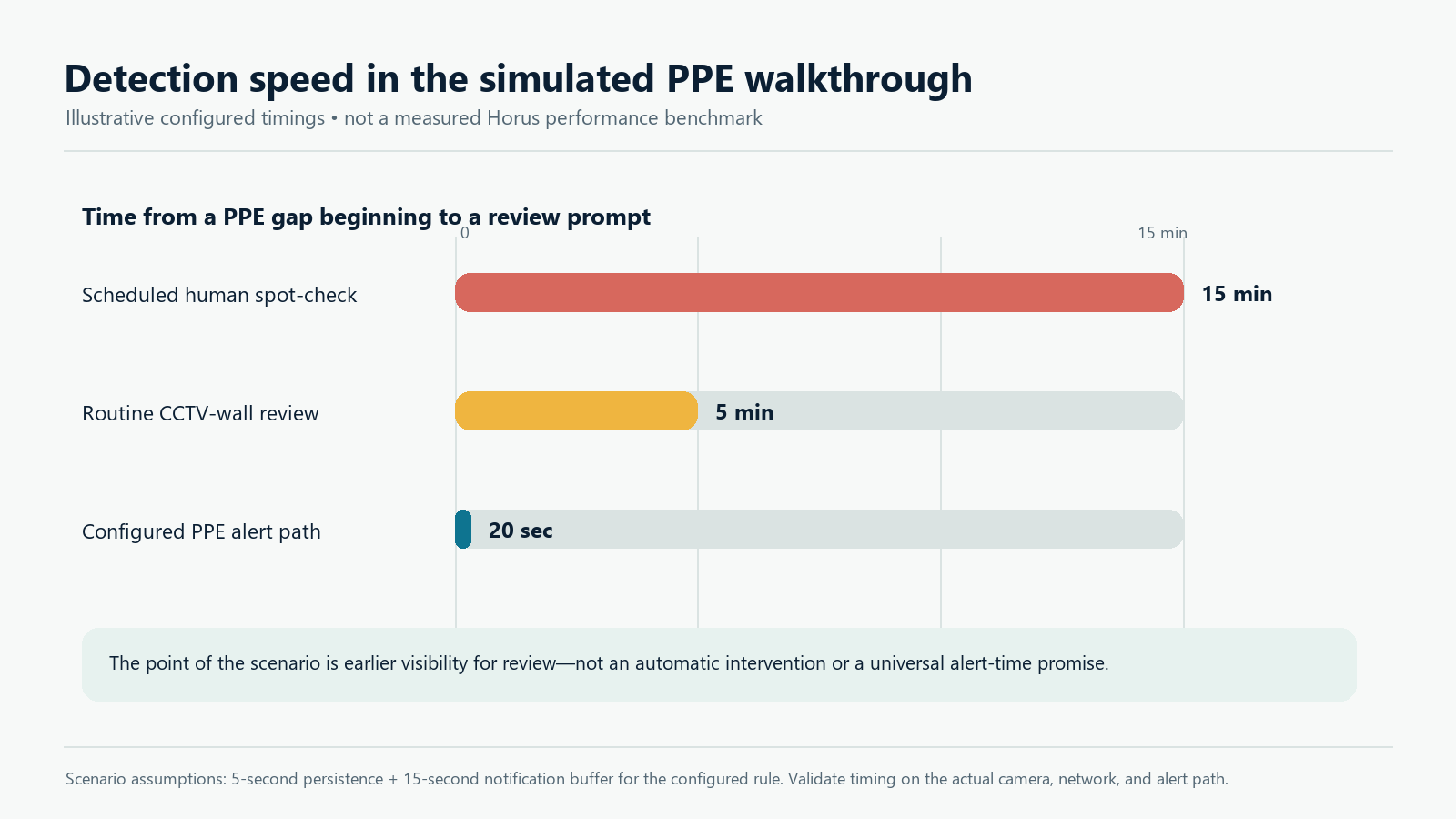
The timing chart compares a 15-minute scheduled spot-check, a five-minute CCTV-wall review, and a 20-second configured alert path. That last figure combines the five-second persistence rule and a 15-second notification buffer. It is illustrative, not a universal alert-time claim; network, notification, camera, lighting, and rule settings matter.
The same design can be tested for a hard-hat, safety-vest, or other PPE condition around a defined machine-access zone. Begin with one narrow rule: name the zone, visible item, persistence period, alert recipient, and first response. Broad rules such as “every worker must always appear fully compliant” are harder to validate and more likely to create noise.
What the impact estimate means
The third chart turns the timing assumptions into a small pilot model. Imagine 100 visible PPE gaps beginning halfway between 15-minute spot-checks: the average human wait is 7.5 minutes per gap, or 750 minutes total. Under the configured 20-second alert assumption, the total wait is 33.3 minutes—716.7 minutes of earlier review opportunity.
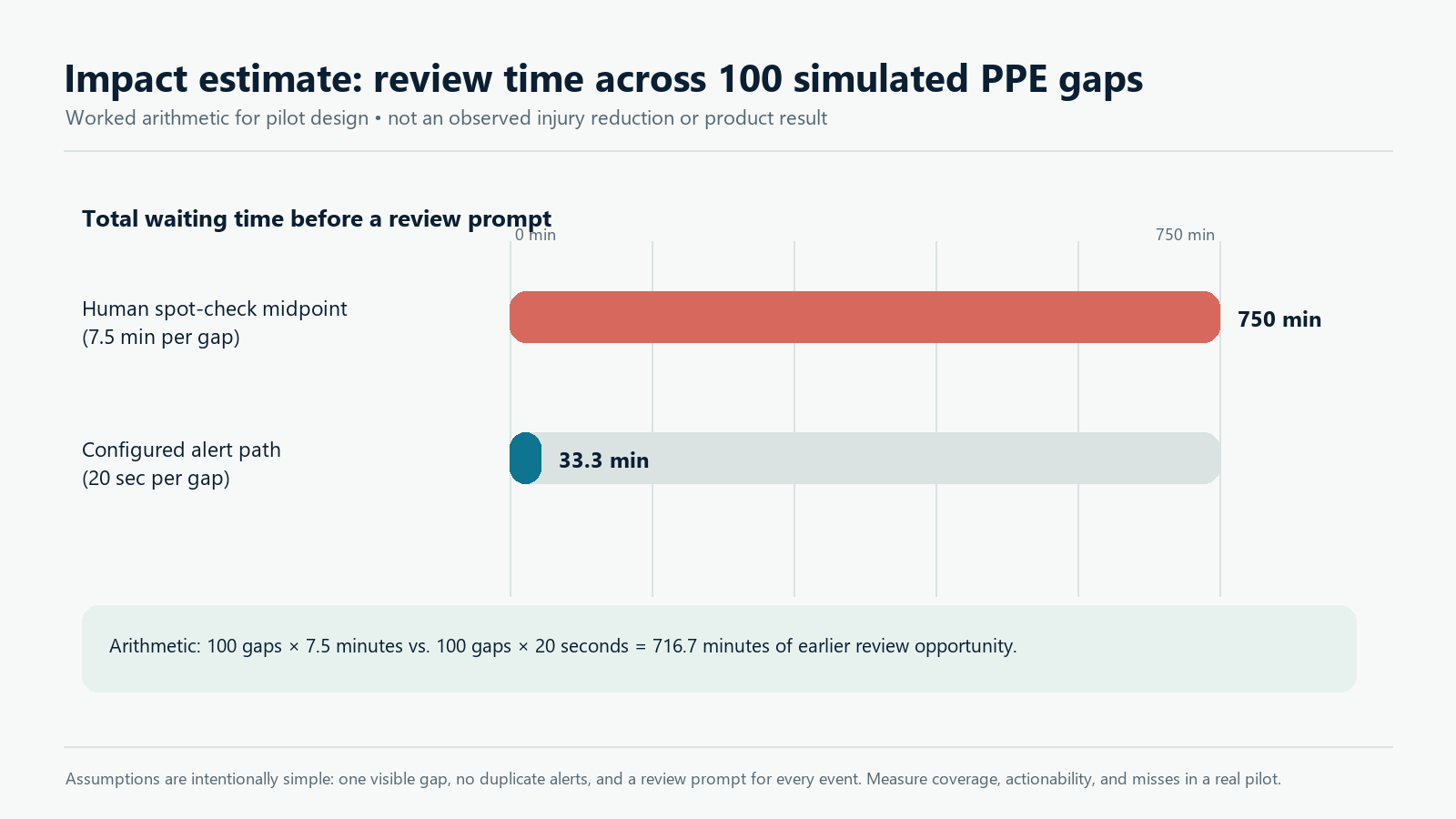
That is not 100 prevented injuries, and it is not an accuracy or compliance result. It is a way to define what a real pilot should measure: how many gaps were visible, how many met the rule, how many alerts were actionable, how often a person was incorrectly flagged, and how many events were missed because of occlusion or field of view.
What this means in practice
PPE detection software is most useful as a leading-indicator layer around a broader safety system. Repeated events may reveal a training gap, difficult access point, uncomfortable vest, poor equipment storage, or camera angle that needs attention. The signal should improve the conversation about controls, not replace a risk assessment.
For a bounded pilot, choose one manufacturing cell and one compatible existing camera. Confirm visibility across shifts, nominate the first reviewer, and log why each event was accepted or rejected. Review false positives after a week, then adjust the zone, persistence, severity, or cooldown. Measure usefulness, not a headline percentage.
Horus uses compatible existing IP cameras, processes inference locally on a Windows PC, and sends detection metadata rather than raw video to the cloud. Its live manufacturing capabilities include PPE detection for hard hats and safety vests, confidence scoring, zone analytics, and configurable alerts. That gives a US or UK safety team a concrete first question: can the existing camera see the required PPE and access zone clearly enough to support a timely human review?
Conclusion
This was a hypothetical demonstration using Horus in a simulated operational environment, not a customer case study. The BLS and HSE figures are real and source-linked; worker tracks, confidence values, alert timing, and impact arithmetic are illustrative.
The practical lesson is that PPE policy is useful when a team can see where it is working, where it is failing, and what should happen next. AI video analytics can make a visible gap easier to review while keeping the human safety process in charge. It works beside training, hazard assessment, equipment selection, physical safeguards, and supervision—not in place of them.
Want to see how Horus would perform with your cameras? Book a demo at horusapp.io →
Sources and method
The injury figures are reproduced from linked BLS and HSE publications using stated years and definitions. The scenario uses a five-second persistence rule, a 15-second notification buffer, 100 simulated gaps, and a 7.5-minute midpoint assumption for scheduled checks. Scenario values are illustrative; no customer dataset is used.