AI Video Analytics for Warehouses: A Simulated Storage-Congestion Demonstration
AI video analytics for warehouses is most useful when it turns a vague feeling—“staging is getting tight”—into a reviewable operating decision. In the United States, the Bureau of Labor Statistics recorded 4.8 total recordable injury and illness cases per 100 full-time workers in warehousing and storage in 2024, compared with 2.3 across private industry. In Great Britain, the Health and Safety Executive recorded 15 worker deaths in transportation and storage in provisional 2025/26 data, while 24 worker deaths across all industries were classified as being struck by a moving vehicle. These figures do not show that congestion caused any particular injury. They do show why clear routes, visible exceptions, and named human responses matter. Here's what Horus detects when we simulate this scenario.
Disclaimer: This is a hypothetical Horus demonstration; all scenarios are illustrative. Timing, confidence, coverage, and impact are not live customer results or measured Horus safety performance.
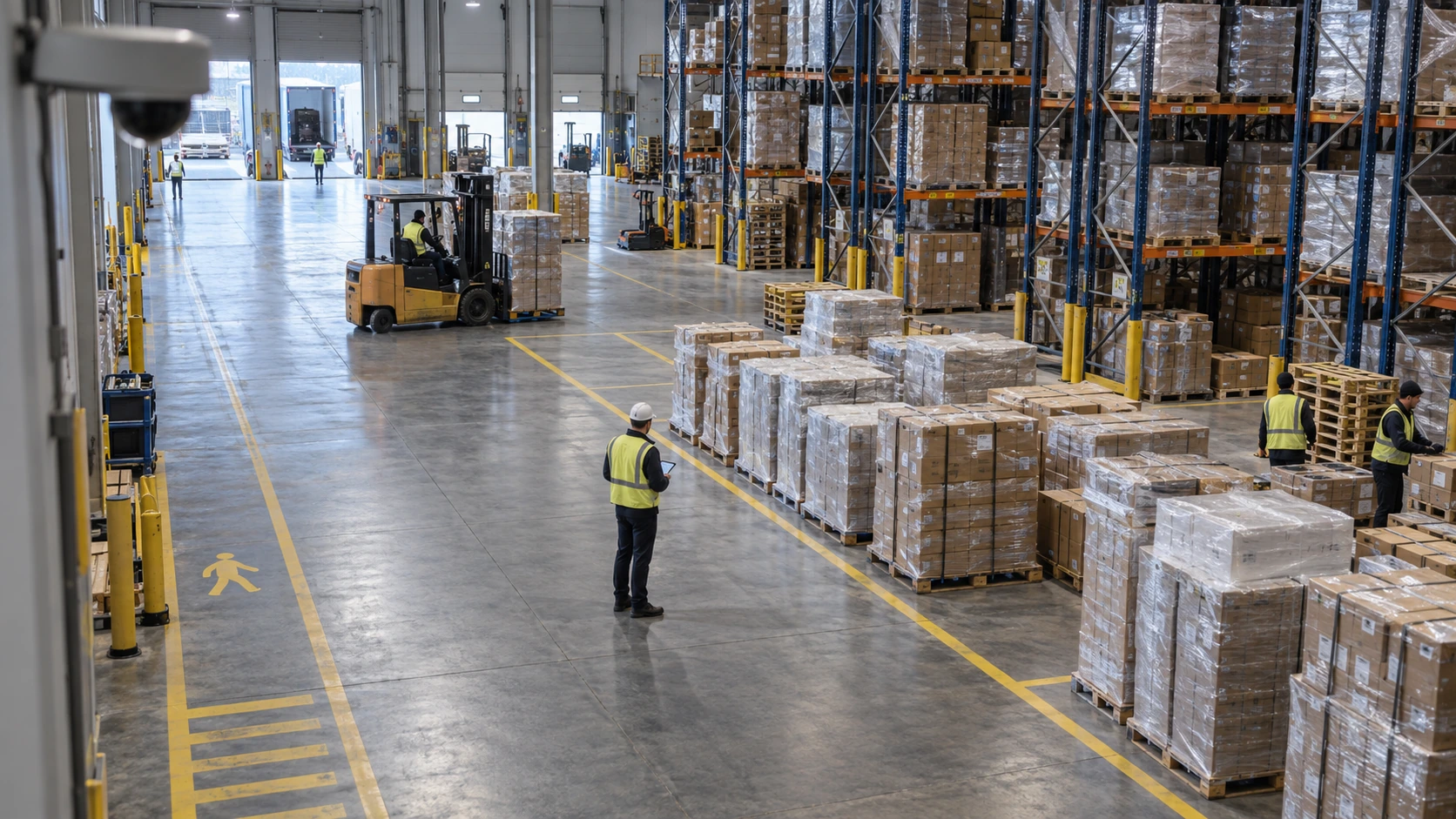
The scenario setup
The simulated site is a medium-sized warehouse with inbound and outbound staging, marked pedestrian aisles, a forklift route, and a camera mounted above one staging zone. The camera already exposes a usable IP stream to a Windows edge computer.
The shift lead defines one narrow rule: if the staging zone remains occupied for 15 seconds while people or vehicles are active in the adjacent route, create a review event. The rule does not attempt to count every pallet, identify a worker, or decide whether material should move. It tests whether camera-defined zone occupancy and dwell signals can give a named supervisor an earlier prompt to inspect the area.
The research baseline
US and UK sources describe the surrounding risk through different measures:
- BLS reports 2.3 total recordable cases per 100 full-time workers across US private industry in 2024, versus 4.4 in transportation and warehousing, 4.8 in warehousing and storage, and 4.9 in general warehousing and storage.
- BLS records 865 fatal work injuries in US transportation and warehousing in 2024, with a fatal injury rate of 12.2 per 100,000 full-time equivalent workers.
- HSE's provisional Great Britain 2025/26 table records 15 worker deaths in transportation and storage and 24 deaths classified as struck by a moving vehicle across industries.
- HSE says nearly a quarter of workplace-transport deaths occur during reversing and advises employers to reduce reversing, separate people and vehicles where possible, and organise safe loading areas.
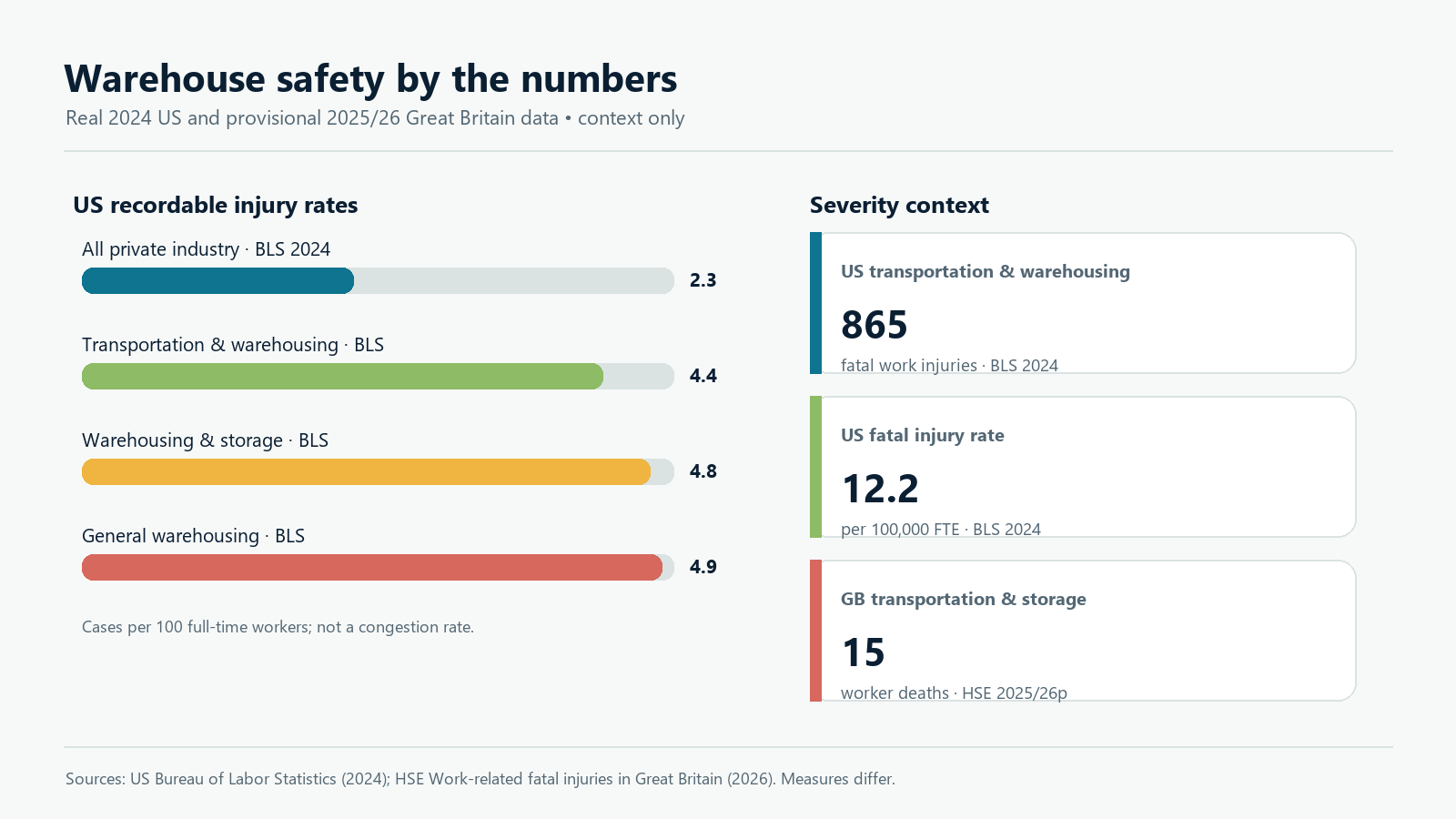
These measures should not be added together or treated as a congestion rate. BLS reports employer-recorded US cases and fatal injuries; HSE reports provisional RIDDOR fatalities for Great Britain; neither dataset isolates blocked staging zones. Their narrower value is to establish the operating context. Warehouses need safe clearances, usable aisles, controlled vehicle movement, and enough visibility for a supervisor to intervene before a local exception becomes a larger process or safety problem.
OSHA's materials-handling standard requires sufficient safe clearances for aisles, loading docks, doorways, and turns when mechanical equipment is used. It also says aisles and passageways should remain clear and that storage should not create a hazard. Camera analytics can make a visible condition easier to review; it cannot replace the site risk assessment, traffic plan, housekeeping, training, or physical controls.
Sources: BLS 2024 incidence-rate table, BLS fatal work injury chart, HSE work-related fatal injuries in Great Britain, HSE loading-area guidance, and OSHA 1910.176 materials handling.
The detection walkthrough
Horus processes the camera stream on the local Windows edge machine, tracks visible people and vehicles, and evaluates the configured zone and dwell conditions. The rule is deliberately narrow because a useful signal needs a clear owner and first response.
At 08:42:01, a forklift and worker are visible; hypothetical confidence values are 0.93 and 0.91. The route is normal, so no event is created.
At 08:42:16, the staging area remains occupied while the forklift pauses and a second worker approaches the aisle boundary. The zone rule starts its 15-second persistence timer. A single frame should not become an escalation: people can cross, a forklift can pause, and an operator may be completing a planned task.
At 08:42:31, the condition has persisted. The simulated event is:
| Time | Event | Zone | Tracks | Confidence | Severity | Review prompt |
|---|---|---|---|---|---|---|
| 08:42:31 | Staging-zone occupancy persists beside an active route | Outbound staging | Person P-08 + vehicle V-02 | 0.91 / 0.93 | Medium | Floor lead checks clearance, route, and planned task |
The notification goes to the named floor lead through a configured alert path. Telegram and email alerts are live Horus capabilities, but the recipient still decides whether this is a planned wave, temporary staging, a blocked route, poor housekeeping, or a layout problem. Horus does not move stock, stop a forklift, identify fault, determine intent, or certify compliance.
A camera-defined zone and dwell rule asks a more practical question than a raw count: has the staging condition persisted long enough for someone responsible to review whether the route remains safe and workable?
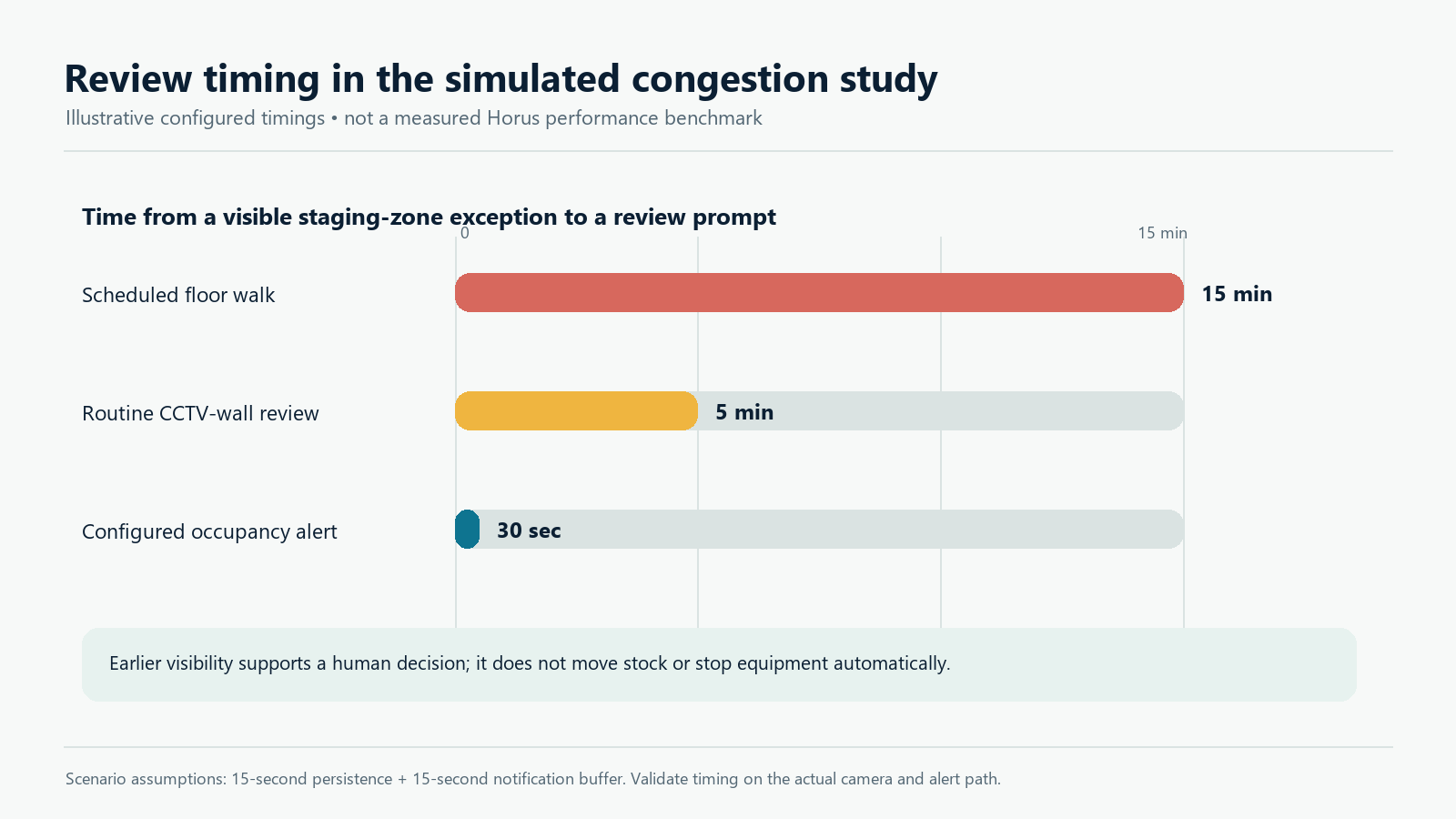
The timing chart compares a 15-minute scheduled floor walk, a five-minute routine CCTV-wall review, and a 30-second configured alert path. The 30 seconds combines a 15-second persistence rule with a 15-second notification buffer. It is not a universal Horus latency promise. Camera angle, lighting, network conditions, hardware, rule settings, and notification delivery all affect a real result.
The same protocol can be tested in an inbound staging lane, a finished-goods buffer, or a pedestrian crossing beside storage. Record visibility, validity, usefulness, and supervisor action. If pallets, shrink-wrap, parked equipment, or normal shift patterns create noise, adjust the zone and rule instead of expanding coverage blindly.
What the impact estimate means
The third chart turns the timing assumptions into a simple pilot model. Imagine 100 visible congestion events beginning halfway between 15-minute floor walks. The average wait for the next walk is 7.5 minutes, or 750 minutes across all events. Under the configured 30-second alert assumption, the total wait is 50 minutes. That creates 700 minutes of earlier review opportunity.
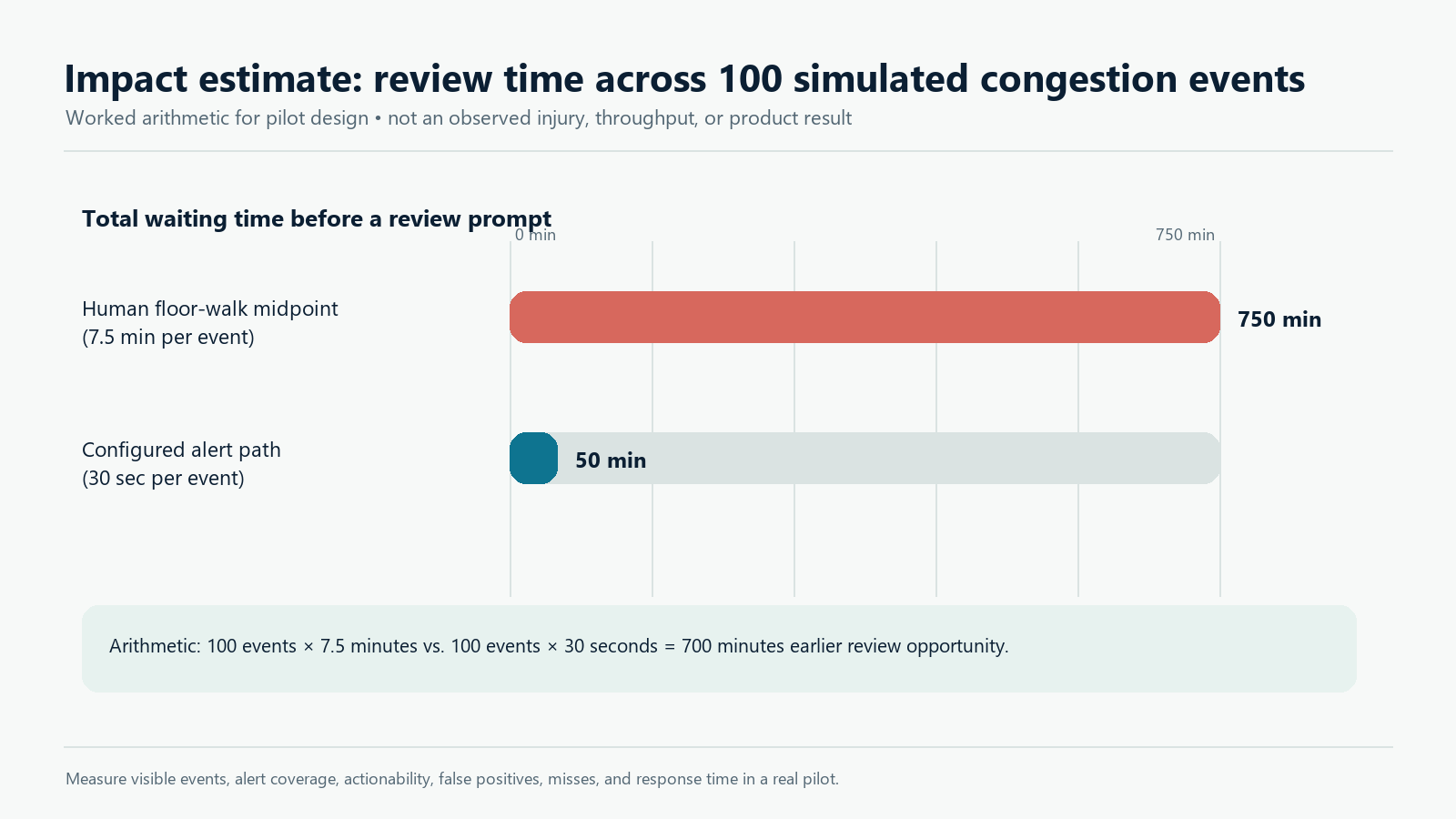
The arithmetic is not a throughput gain, injury reduction, or claim that 100 exceptions would be resolved. It is a measurement design. A real pilot should record visible events, alert coverage, false positives, misses, review time, response usefulness, and any change to a route, staging limit, housekeeping practice, or shift procedure.
What this means in practice
Warehouse camera analytics works best as a leading-indicator layer around an existing operating system. A repeated staging exception may point to a late wave, a missing buffer, a poorly placed camera, a route that is too narrow, or a handoff that has no clear owner. The signal should help a manager ask the right question; it should not pretend to know the answer.
A bounded proof protocol looks like this:
- Select one existing IP camera with a stable view of one staging zone.
- Draw the smallest useful zone and name one floor lead as the first reviewer.
- Run the rule in review-only mode long enough to cover normal and peak shifts.
- Label each event as useful, normal activity, not visible, or missed.
- Change one control at a time: zone boundary, persistence, cooldown, route, or response step.
Horus's verified foundation supports existing IP cameras, local video processing on a Windows machine, object tracking, zone occupancy, dwell-time analysis, confidence scoring, and configurable alerts. The supervised proof protocol above is feasible with those camera-first capabilities. Automatic stock movement, vehicle control, cross-system scheduling, and closed-loop resolution remain roadmap work, not live product claims.
Related reading: how to add AI to existing cameras and edge AI vs cloud AI camera analytics.
Conclusion
This was a hypothetical demonstration using Horus in a simulated operational environment, not a customer case study. The BLS, HSE, and OSHA references are real and source-linked; the tracks, confidence values, alert timing, rule coverage, and impact arithmetic are illustrative.
The practical lesson is that warehouse congestion is not only a space problem. It is a timing and ownership problem: when a zone stays occupied, who sees it, who checks it, and what safe action follows? AI video analytics can make that condition reviewable earlier from existing cameras, while the warehouse team remains responsible for the risk assessment, route design, housekeeping, training, and decision.
Want to see how Horus would perform with your cameras? Visit horusapp.io →
Sources and method
The BLS and HSE figures are reproduced from the linked publications using the years, provisional status, and definitions stated above. The OSHA reference is a materials-handling standard, not an injury dataset. The scenario uses a 15-second persistence rule, a 15-second notification buffer, 100 simulated congestion events, and a 7.5-minute midpoint assumption for scheduled floor walks. All scenario values are illustrative; no customer dataset or dashboard screenshot is used.